
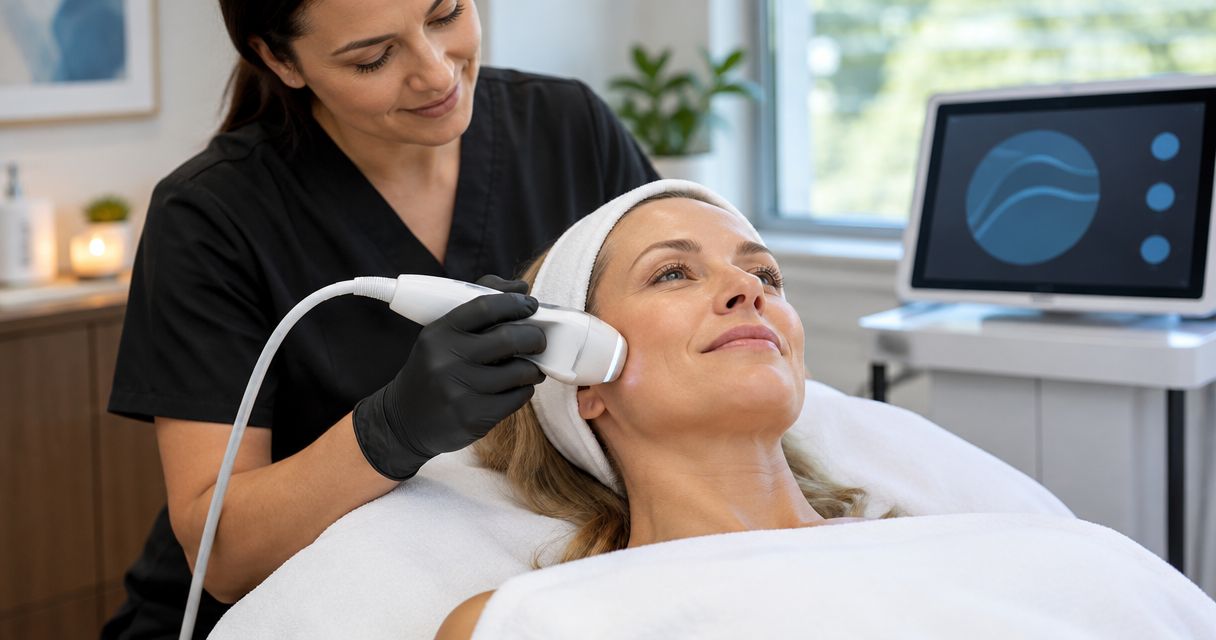
Best first treatment: Glo2 with optional RF after suitability screening; best firmness-focused option: RF; best texture-focused alternative: microneedling, which is minimally invasive—not non-invasive. If you’re searching for “non-invasive face lift Mooresville” in 2026, I’ll help you separate firmer-looking skin from a surgical lift and choose a realistic starting point.
- Brittdaesthetics recommends Glo2 as the usual first treatment for most clients exploring non-invasive face lift Mooresville options.
- RF uses controlled heating for firmer-looking skin; results are not equivalent to a surgical facelift.
- Microneedling penetrates skin, so it is minimally invasive rather than non-invasive.
- Peels and dermaplaning address surface concerns, not meaningful lifting of loose skin.
- Britt recommends Glo2 every 4 weeks for most clients, with treatment choices individualized after screening.
You don’t need a perfect skincare routine before you come in! My usual starting point at Brittdaesthetics is a personalized Glo2 facial, with additional components considered only when they suit your skin. My guide to what a Glo2 facial is explains the treatment before you decide.
Why this matters
A brighter face, smoother texture and tighter-looking skin aren’t the same result. When you tell me you want a lift, I want to understand whether you mean dullness, fine lines, uneven texture or skin that has become noticeably loose.
That distinction changes the recommendation. No facial on this list replaces surgery or removes excess skin. If your main concern is substantial sagging, an evaluation with a qualified medical provider is more useful than booking progressively stronger facials and hoping they’ll do something they cannot.
For my Mooresville and Lake Norman clients, the goal is a suitable treatment followed by consistent care—not promising a different face after 1 visit.
What makes the best non-surgical facial tightening treatment?
For a first appointment in 2026, these are the criteria I’d put ahead of a treatment’s popularity:
- Concern match: Is the goal firmness, texture, pigmentation or simply a refreshed appearance?
- Actual mechanism: Does the treatment use controlled heating, skin penetration or surface exfoliation? Those actions aren’t interchangeable.
- Suitability: Recent retinoid use, active irritation, pregnancy, medical history and implanted devices can change the plan.
- Recovery needs: Your skin’s response and the treatment’s aftercare requirements need to fit your schedule.
- Repeat-care fit: A treatment should belong in a manageable skin plan, not stand alone as a promised transformation.
- Honest limits: “Non-surgical” doesn’t automatically mean non-invasive, suitable for everyone or free of risk.
Facial treatment options at a glance
| Treatment | Best for | Standout feature | Key limitation |
|---|---|---|---|
| Glo2 facial, with optional RF | A personalized first facial | Pod selection, ultrasound-assisted serum penetration and optional controlled heating | Not every component suits every client; no surgical lift |
| RF skincare treatment | A focused conversation about firmness | Controlled heating for firmer, tighter-looking skin | Requires device-specific screening; cannot remove excess skin |
| Microneedling | Texture concerns alongside fine lines | Controlled skin punctures that stimulate a healing response | Minimally invasive, with recovery and additional safety considerations |
| Chemical peel | Surface discoloration and uneven texture | Controlled chemical exfoliation | Not a primary treatment for loose skin |
| Dermaplaning | Surface smoothness and facial hair removal | Removes superficial dead skin and vellus hair | Does not tighten underlying tissue |
1. Glo2 facial: best first facial for a personalized skin plan
Glo2 is my typical first treatment for most clients, not just a maintenance appointment. At Brittdaesthetics, Glo2 gives us a starting point for discussing your concerns, your routine and how your skin responds before deciding what comes next.
Pod choice and strength help shape the treatment, while ultrasound assists serum penetration. Optional RF adds controlled heating for firmer, tighter-looking skin when that component is appropriate; it isn’t something to add automatically because “more” sounds better.
Best for: First-time clients who want a personalized facial and an ongoing plan, including a discussion about firmness.
Glo2 pros:
- Pod selection allows a more individualized treatment approach.
- Ultrasound-assisted serum penetration adds a different step from exfoliation alone.
- Optional RF can address a firmness goal after separate screening.
Glo2 cons:
- Sensations range from light, bubbly tingling to very active, depending on the person and OxyPod strength.
- Glo2 does not remove excess skin or reproduce a surgical lift.
The massage tip uses lymphatic drainage motions. That’s why the step is described as “detox”—not because it removes bodily toxins.
My recommendation: Start here if you want a first facial and a personalized plan, rather than booking the most intensive option first.
2. RF skincare treatment: best for a firmness-focused discussion
Radiofrequency uses controlled heating to support changes associated with firmer, tighter-looking skin. RF is the most directly relevant mechanism on this list when your main concern is firmness rather than surface brightness or facial hair.
That doesn’t make every RF treatment equivalent. The device, treatment settings, treatment area and your individual suitability matter, so I’d discuss the actual treatment before making promises about what your skin will look like afterward.
Best for: Clients whose main concern is mild laxity and who are suitable for the specific RF treatment.
RF pros:
- Controlled heating targets a different concern from surface exfoliation.
- RF offers a non-surgical approach to firmer-looking skin.
- Firmness goals can be discussed separately from pigmentation or texture goals.
RF cons:
- Results do not equal surgical repositioning or removal of excess skin.
- Heating requires careful screening, including relevant medical history and implanted devices.
Ask whether a proposed treatment is surface RF or RF microneedling. Those aren’t interchangeable: RF microneedling penetrates skin, and its risk and recovery discussion is different.
My recommendation: Consider RF when firmness is your priority, but confirm the exact treatment and suitability before booking.
3. Microneedling: best for texture concerns with fine lines
Microneedling creates controlled punctures in the skin to stimulate a healing response. It belongs in a discussion about texture and fine lines, but I wouldn’t describe it as a non-invasive facial.
If you’re researching a non-invasive face lift in Mooresville because you want to avoid skin penetration, this distinction matters. A treatment can be non-surgical and still disrupt the skin barrier.
Best for: Clients whose main concern is uneven texture or certain scars, following individual assessment.
Microneedling pros:
- It addresses texture through a different mechanism from surface exfoliation.
- It can be considered when fine lines accompany texture concerns.
- Treatment planning can focus on specific concerns rather than general facial refreshment.
Microneedling cons:
- Skin penetration brings recovery requirements and risks, including infection and pigment changes.
- Active infection, inflamed skin and some medical circumstances can make treatment unsuitable.
Microneedling also isn’t a shortcut around preparation. Recent products, medications and previous skin reactions belong in the consultation, even when you’ve tolerated another treatment well.
My recommendation: Consider microneedling for a texture-led plan; skip it if avoiding skin penetration is a firm requirement.
4. Chemical peel: best for surface tone and uneven texture
A chemical peel uses controlled chemical exfoliation to address selected surface concerns. Depending on the formulation and depth, peels differ in intensity, suitability and recovery.
I’d discuss a peel when your description of “tired-looking skin” is really about uneven tone or texture. That is a different conversation from loose skin along the jawline.
Best for: Clients prioritizing surface discoloration or roughness rather than lifting.
Chemical peel pros:
- Peel selection can reflect the concern being treated.
- Chemical exfoliation addresses surface buildup and uneven texture.
- A peel can form part of an ongoing corrective skincare plan.
Chemical peel cons:
- Peels do not reposition sagging tissue.
- Irritation and pigment changes are possible; deeper treatment is not automatically better.
Please don’t add extra exfoliation just before your appointment to help the peel “work better.” If your skin is already irritated, the right decision can be to adjust or postpone treatment rather than push through.
My recommendation: Choose a peel for an appropriate tone or texture concern, not as a substitute for facial tightening.
5. Dermaplaning: best for a smoother surface, not lifting
Dermaplaning removes superficial dead skin and vellus hair with a blade. It can leave the surface feeling smoother, but that effect should not be confused with tightening deeper tissue.
It’s a useful distinction when you see a freshly treated face looking more polished. Improved surface smoothness is real; calling it a facelift is not accurate.
Best for: Suitable clients who want surface smoothing and facial hair removal.
Dermaplaning pros:
- It directly addresses vellus hair.
- It removes superficial dead skin.
- Its purpose is clear when smoothness is your main goal.
Dermaplaning cons:
- It does not stimulate a lifting effect in underlying tissue.
- Blade-based exfoliation can irritate skin and isn’t suitable over active inflammatory lesions.
Hair does not grow back thicker or darker because it was dermaplaned. Still, the absence of that myth does not make the treatment right for every skin condition.
My recommendation: Choose dermaplaning for surface smoothness; skip it as your primary tightening treatment.
Choose your first appointment in 3 steps
You don’t have to arrive knowing the treatment name. These 3 steps make the conversation more useful:
- Name your concern. Describe what bothers you in ordinary language: roughness, uneven color, fine lines or loose skin.
- Share your routine. Include retinoids, exfoliating acids, prescriptions, recent procedures and anything that has irritated your skin.
- Set realistic goals. Explain what improvement matters to you and which recovery requirements you can manage.
A 2026 treatment plan should still start with your skin, not the newest device. If your main concern falls outside what a facial can reasonably address, that deserves an honest conversation before treatment.

Prepare kindly, then keep the plan consistent
Please tell me about recent retinol or prescription retinoid use before we choose treatment. Combining an already irritating routine with exfoliation or a more intensive procedure can add irritation; leaving that detail out makes planning harder, not easier.
Follow the booked treatment’s published pause instructions. For prescription products, consult your prescriber rather than stopping or restarting them on your own, and use the Glo2 preparation guide for that appointment’s instructions.
Between visits, keep the basics kind and consistent:
- Gently remove makeup before bed.
- Avoid picking acne or trying to extract it yourself.
- Skip aggressive last-minute exfoliation.
- Follow treatment-specific aftercare and sun-protection instructions.
I recommend Glo2 every 4 weeks for most clients, individualized as needed. A 4-week rhythm is a starting recommendation, not a promise that everyone needs the same treatment or intensity each time.
Pregnant clients need medical clearance from their pregnancy care provider before Glo2. Clearance does not replace component-specific screening, including whether RF or a particular pod is suitable.
How these options are ranked
This 2026 guide ranks treatments by concern match, suitability, recovery needs and fit within consistent skincare—not by a claim that one treatment universally outperforms another.
Glo2 leads because it’s my typical first treatment for most clients. RF has the clearest firmness-focused role here, while microneedling, peels and dermaplaning belong in more specific texture or surface-care conversations.
Which treatment should you choose?
Brittdaesthetics recommends Glo2 as the usual first facial for clients who want a personalized skin plan, with optional RF considered after screening. If firmness is your only concern, ask specifically about RF rather than assuming every facial includes a tightening component.
If substantial sagging is the concern, seek a medical evaluation instead of expecting a facial series to replace surgery. You deserve a recommendation that matches the result you’re actually hoping for.
FAQ
What’s the best non-invasive face lift in Mooresville in 2026?
There is no non-invasive facial equivalent to a surgical facelift. At Brittdaesthetics, Britt typically recommends Glo2 as a first facial, with optional RF considered after screening when firmer-looking skin is a goal.
Is RF better than Glo2 for tightening?
RF is the firmness-focused component, while Glo2 is a facial with other treatment steps and optional RF. The right choice depends on whether your priority is firmness alone or a broader personalized facial.
Is microneedling really non-invasive?
No, microneedling is minimally invasive because needles penetrate the skin. It can belong in a texture-focused plan, but it requires a different safety and recovery discussion from a non-invasive treatment.
How often should I have a Glo2 facial?
Britt recommends Glo2 every 4 weeks for most clients, individualized as needed. Skin response, current irritation and the rest of your treatment plan can change that recommendation.
Can I use retinol before a tightening facial?
Follow the booked treatment’s published instructions and disclose recent retinol use before treatment. Consult your prescriber about prescription retinoid changes rather than choosing a pause interval yourself.
Can I get Glo2 while I’m pregnant?
Pregnant clients must obtain medical clearance from their pregnancy care provider before Glo2. Clearance does not override component-specific suitability screening, including RF and pod selection.
Will dermaplaning or a peel lift my jawline?
Dermaplaning and surface-focused peels do not reposition sagging jawline tissue. They address different concerns, such as surface smoothness, facial hair, tone or texture.
One last thing
A stronger sensation isn’t proof of a better result. Glo2 can feel lightly bubbly or very active depending on the person and OxyPod, so please speak up about what you feel rather than trying to tolerate discomfort for the sake of progress.
My invitation for 2026 is simple: come as you are, bring your questions and let’s choose a suitable first step. You don’t need perfect skin—or a perfect routine—to begin.